 |
The Södertälje lock.
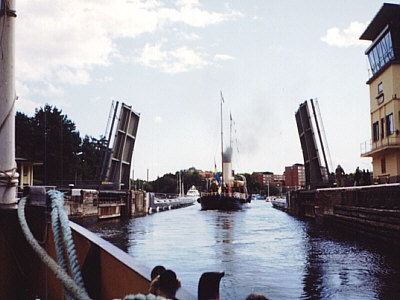 The lock in Södertälje is something Ejdern, her crew and passengers get in touch with every time she goes into lake Mälaren and back into the Baltic as her jetty is on the Baltic side of the lock. It could perhaps be of interest with some information about something as important for us and which also gives our town such character. The lock in Södertälje is something Ejdern, her crew and passengers get in touch with every time she goes into lake Mälaren and back into the Baltic as her jetty is on the Baltic side of the lock. It could perhaps be of interest with some information about something as important for us and which also gives our town such character.
The Södertälje lock is part of the shipping area streching from the Baltic south of Landsort, covering the whole of lake Mälaren and lake Hjälmaren too.
Many tasks! The main task in this area is to create conditions for an efficient and safe shipping including Södertälje canal and lock. Maintenance and piloting are the most important parts of the job plus operating the lock and bridges in Södertälje together with being the shipping authority in the area. The present modern Södertälje lock was opened November 19, 1924 by king Gustav V.
It is one of Scandinavia´s biggest locks, 135,0 meters (442 feet) long, 19,6 m (64 feet) wide and 8,3 m (27 feet) deep, though ships are aloud to use a depth of just 7 m (23 feet). Originally the passage was opened October 7, 1819.
Many cubics! Some figures regarding the lock can be of interest. Let´s start with the water, the differens of the water level between the Baltic and lake Mälaren, the cause of the lock, differs from 50 centimeters (19 inch) to 120 (42 inch) and the Baltic is the lower one. Every time the lock is opened towards the Baltic 4000 cubic meters (108.000 cubic feet) of water are let from Mälaren. The water level of the lake is mainly controled by two locks in Stockholm but at spring flood even by a third Stockholm lock and our lock. An average year the let out of water is about 4,7 billion cubic meters (127 q-feet), that is 535 000 cubic meters (14 million q-feet) every hour or 150 cubic meters (4050 q-feet) every second! At the same time 3 million people use the water of Mälaren for their daily consumption.
Many tons!During 1999 4012 cargo ships transported no less than 4 600 000 tons of goods through the canal and lock to or from the Mälaren harbors (mostly to) equivalent to 155 000 transport lorries. If you put them on a row they would reach from northern Sweden to north Africa.
Many meters! 10 436 leisure boats went through the lock, both ways. At peaks in the summer the lock can take more than 40 boats, depending on the size of them and the lock opens for them every half hour. The biggest ship the lock can manage is M/S Holmön. She is the same size as the lock, 135 m (442 feet) long and 18,14 m (60 feet) wide and 7 m (23 feet) deep. At such a time quite a parking skill is required! She can't take a full load though as she would be 8,4 m (28 feet) deep then. Usually she carries a cargo of about 7600 tons of coal, that would be some 250 lorries.
Many people! 85 people work in this area, one area manager, one operation manager and 35 pilots. 18 VTS operators (Vessel Traffic Service) work in the control tower by the lock and supervise the lock and bridges by computers, cameras and monitors. On one of the walls there is a huge marine chart where the movements of the ships are marked by different colored magnets.
These operators serve the clock around, three at the time. There is no conventional education to be such an operator, but many of them are former seamen, and knowledge of languages, service and computors help. Three boatswains work in Södertälje, they form the passage group and carry out the maintenance of bouys and light houses and such, using their own vessel. Six technicians, electricians and workmen maintain the canal and lock and at last, but not least, five people take care of the administration. Finally 15 boatswains work at Landsort and one person takes care of them.
Many kilometers! When a vessel informs about it´s arrival the opening of the lock and bridges is prepared in good time, kilometers before the arrival. In spite of modern equipment on ships, as bow thrusters and such it´s ofcourse bad with a emergency stop in the canal. The VTS operators are given notice of arriving vessels by agents and harbours sending lists, mostly by facsimile. Contact with ships then are maintained by the VHF marine radio. Pilots, a must for most vessels in these narrow waters, are ordered by ship agents and has to be done five to twelve hours in advance and confirmed three hours before the pilot is needed. Vessels that are frequently trafficing these waters don´t always need a pilot as someone in their own crew holds the authority of a pilot.
Many crowns! You cannot pass this area without paying, cargo vessels pay a passage fee and pay the pilots by bills, leisure boats pay cash when entering the Baltic. Small passenger vessels don't pay at all, that's not the costume, but Ejdern when passing the lock always pays her `fee´ with a bag of buns and cakes for the VTS operators in charge that day. These operators also get out on the quay to assist all ships, all sizes from Holmön to Ejdern and smaller and collect the fee from the leisure boats.
Many thoughts! One must say they did think ahead when they built the lock 75 years ago. Not until now have there been discussions about making the lock bigger, ports in lake Mälaren want bigger vessels to be able to reach them. How all this will turn out nobody knows yet.
Birgitta Bengtsson,
|
 |
|